
Home Solution Data Migration

Data Migration

Service Detail

Data Migration

We help organizations migrate business-critical data from legacy systems and existing ERP platforms into Microsoft Dynamics 365 with accuracy, security, and minimal business disruption.

Description

Successful Dynamics 365 implementation depends on having accurate, reliable, and well-structured business data. Magnifia IT Solutions provides comprehensive Dynamics 365 data migration services that help organizations move critical information from legacy applications, existing ERP platforms, databases, spreadsheets, and other business systems into Microsoft Dynamics 365.

Our data migration approach begins with understanding your existing data landscape, business requirements, data structures, and target Dynamics 365 environment. We assess the quality and relevance of your existing information, identify duplicate or outdated records, and define a clear migration strategy designed around your business objectives.

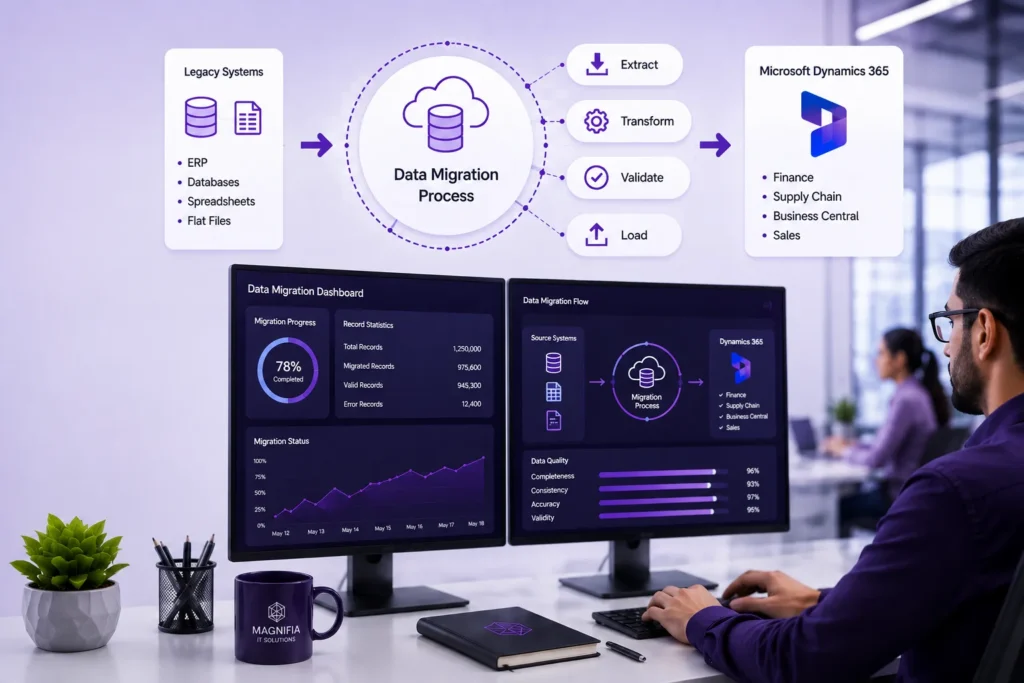
Our consultants manage the complete migration lifecycle, including data discovery, extraction, cleansing, transformation, mapping, migration, validation, testing, and deployment. We help ensure that customer records, financial information, products, suppliers, inventory, transactions, and other critical business data are transferred accurately into the new environment.

We also help organizations address common migration challenges such as inconsistent data formats, duplicate records, incomplete information, legacy customizations, complex relationships, and differences between source and target systems. Through structured validation and testing, we help identify discrepancies before they affect business operations.

Whether you are moving to Dynamics 365 Finance, Dynamics 365 Supply Chain Management, Business Central, or another Microsoft business application, our team provides a controlled and scalable migration process. We combine technical expertise with an understanding of business processes to ensure your data supports the way your organization operates.

With Magnifia IT Solutions, data migration is more than moving records from one system to another. It is an opportunity to improve data quality, simplify information management, establish reliable business processes, and create a stronger foundation for analytics and future growth.

Service Process

number10

Discover & Assess

We analyze your source systems, data structures, dependencies, quality issues, and business requirements to create a clear migration strategy.

number11

Cleanse & Migrate

We extract, cleanse, transform, map, and migrate your data into Dynamics 365 using structured processes designed to maintain accuracy and consistency.

number12

Validate & Deploy

We validate migrated records, perform business testing, resolve discrepancies, and support a controlled deployment into your production environment.

Business Outcome

Accurate and reliable business data in Dynamics 365

Reduced duplicate, outdated, and inconsistent records

Lower migration risk and minimal operational disruption

A scalable data foundation for reporting, automation, and growth

Frequently Asked Questions

Dynamics 365 data migration is the process of moving business information from legacy applications, databases, spreadsheets, or existing ERP systems into Microsoft Dynamics 365. The process typically includes data assessment, extraction, cleansing, transformation, mapping, migration, validation, and testing.

Depending on the business requirements and target Dynamics 365 application, organizations can migrate customer information, vendors, products, inventory, financial data, transactions, employees, projects, historical records, and other business information.

We use structured data mapping, cleansing, transformation, validation, reconciliation, and testing processes. Migrated records are checked against the source data and business requirements to identify discrepancies before production deployment.

Yes. We can help organizations assess and migrate data from legacy ERP platforms, databases, spreadsheets, and other business applications into the appropriate Dynamics 365 environment. The migration strategy depends on the source system, data structure, volume, and target application.

Migration timelines vary depending on data volume, number of source systems, data quality, transformation requirements, integrations, and testing complexity. A detailed assessment helps establish the appropriate migration scope, timeline, and deployment strategy.

Scroll to Top
Connect With Our Experts

Fill in your details and we will connect with you.