Artificial intelligence is rapidly changing the way businesses interact with enterprise software. Instead of navigating multiple screens, searching through reports, and manually combining information from different systems, business teams can increasingly use AI to understand data, identify problems, make recommendations, and support business processes.
One of the significant developments in this area is Copilot Cowork with Dynamics 365 ERP.
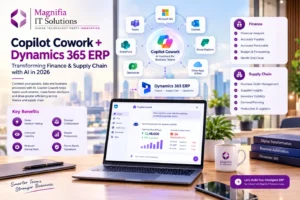
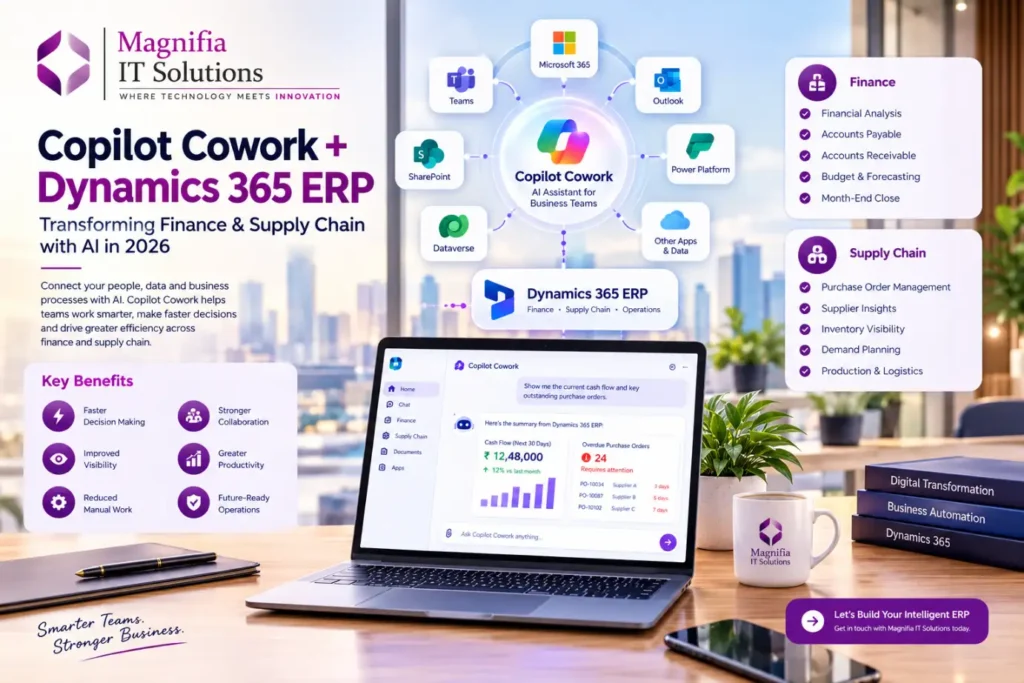
Copilot Cowork is designed to act as an AI-powered orchestrator that can work across business information, enterprise applications, and Microsoft 365 data. When connected with Dynamics 365 ERP capabilities, it can help users analyze finance and supply chain information, identify relevant business context, coordinate workflows, and support actions within the ERP environment.
For finance leaders, supply chain managers, operations teams, and business decision-makers, this represents an important shift from traditional ERP interaction toward AI-assisted and agentic ERP operations.
In this guide, we explore how Copilot Cowork and Dynamics 365 ERP can transform finance and supply chain processes in 2026, the business benefits, practical use cases, implementation considerations, and how organizations can prepare for the next generation of intelligent ERP.
What Is Copilot Cowork?
Copilot Cowork is an AI-powered orchestration capability designed to help users work across business applications and information sources through natural-language interactions.
Traditional ERP systems require users to understand application navigation, menus, reports, forms, filters, and business processes. Although modern ERP platforms have become significantly easier to use, employees can still spend considerable time searching for information and moving between systems.
Copilot Cowork introduces a different approach.
Instead of asking users to manually locate information across multiple systems, AI can help bring relevant information together and provide a contextual response.
For example, a finance manager could ask a question such as:
“Which customers have overdue balances that could affect this month’s cash flow?”
The AI can help analyze relevant ERP information and provide insights that would otherwise require users to navigate multiple reports.
Similarly, a supply chain manager could ask:
“Which purchase orders are overdue and could affect production next week?”
The goal is not simply to provide a chatbot interface. The larger opportunity is to use AI to understand business context, reason across information, and help coordinate business workflows.
How Copilot Cowork Works with Dynamics 365 ERP
The combination of Copilot Cowork and Dynamics 365 ERP brings together AI orchestration with enterprise business data.
Dynamics 365 ERP environments contain valuable information related to finance, procurement, inventory, sales, customers, vendors, projects, supply chain operations, and other business processes.
Copilot Cowork can help connect these business processes with AI-driven reasoning and workflow orchestration.
An important part of this architecture is the Dynamics 365 ERP MCP Server, which enables AI capabilities to interact with ERP functionality through supported tools and business operations.
This creates opportunities for AI to work with different types of ERP capabilities, including:
- Reading business records and ERP data
- Creating or updating supported records
- Searching business information
- Working with ERP forms and pages
- Supporting business actions
- Combining ERP information with Microsoft 365 context
- Orchestrating multi-step business workflows
- Providing recommendations based on business information
Appropriate permissions and business controls remain essential. AI should operate within the access rights and governance policies defined by the organization.
Why AI-Powered ERP Is Becoming Important in 2026
ERP systems have traditionally been systems of record. They store critical information and provide structured processes for managing business operations.
The next evolution is making ERP systems more intelligent and proactive.
Businesses increasingly want systems that can help answer questions such as:
- What is causing a cash-flow problem?
- Which invoices require attention?
- Which suppliers are creating delays?
- Which customers have increasing credit risk?
- Which purchase orders could impact production?
- Which inventory items may become unavailable?
- What financial tasks should the team prioritize today?
- Which operational activities could be automated?
AI can help transform ERP from a system employees primarily navigate into a system that can actively assist employees with decision-making and business processes.
This is where agentic ERP becomes increasingly important.
Copilot Cowork for Finance Teams
Finance departments manage large volumes of structured and unstructured information. Financial data may exist across ERP records, emails, spreadsheets, documents, approvals, and collaboration platforms.
Copilot Cowork can help finance teams bring this information together and work with it more efficiently.
1. Financial Data Analysis
Finance professionals can use natural-language questions to explore business information instead of manually searching through multiple reports.
For example:
“Show me the customers with the highest overdue balances and summarize the potential impact.”
AI-assisted analysis can help finance teams identify important patterns and prioritize their attention.
2. Accounts Payable Support
Accounts payable teams can spend significant time reviewing invoices, vendor information, purchase orders, and payment-related records.
AI can help identify relevant information and support workflows around invoice processing.
For example, a finance user could ask:
“Find vendor invoices that require attention because of missing information or exceptions.”
The AI can help organize the relevant information and reduce manual investigation.
3. Accounts Receivable and Collections
Cash flow is one of the most important concerns for many organizations.
Copilot-assisted workflows can help teams analyze outstanding customer balances, identify overdue invoices, and prioritize collection activities.
Instead of manually reviewing customer records, finance teams can use conversational queries to investigate financial situations more quickly.
4. Month-End and Close Activities
Month-end closing involves multiple activities across financial processes.
AI-powered workflows can help teams identify outstanding tasks, analyze exceptions, and coordinate information required for closing activities.
The goal is not to eliminate financial controls but to reduce repetitive investigation and administrative work.
5. Financial Decision Support
Executives and finance leaders can use AI to explore financial information in a more conversational way.
For example:
“What changed significantly compared with last month?”
AI can help summarize relevant information and highlight areas requiring deeper investigation.
Human review remains essential for important financial decisions.
Copilot Cowork for Supply Chain
Supply chain operations involve complex relationships between suppliers, purchase orders, inventory, warehouses, transportation, production, and customer demand.
AI can help supply chain teams connect these different areas.
1. Purchase Order Analysis
A supply chain manager could ask:
“Which open purchase orders are overdue?”
Instead of manually reviewing large lists, AI can help identify relevant records and summarize the situation.
2. Supplier Risk Identification
Organizations can analyze supplier-related information to identify potential operational risks.
For example, AI could help identify suppliers associated with delayed orders or recurring exceptions.
This allows supply chain teams to focus on areas that may have the greatest business impact.
3. Inventory Visibility
Inventory problems can affect production, customer fulfillment, and revenue.
AI-assisted ERP analysis can help users investigate questions such as:
- Which products have low inventory?
- Which items have unusual demand?
- Which materials may affect upcoming production?
- Which warehouses have inventory imbalances?
By asking questions conversationally, users can investigate operational information without relying entirely on manual report navigation.
4. Procurement Support
Procurement teams manage vendors, purchase orders, pricing, delivery schedules, and approvals.
AI can assist with finding relevant purchasing information and supporting multi-step procurement workflows.
This can help procurement professionals spend less time searching for information and more time negotiating, managing suppliers, and improving purchasing strategies.
5. Supply Chain Exception Management
One of the most valuable applications of AI is helping teams focus on exceptions.
Rather than reviewing thousands of normal transactions, AI can help identify transactions that require human attention.
This approach can improve operational efficiency while keeping people involved in important decisions.
From Chatbots to AI Agents
There is an important difference between a traditional chatbot and an AI-powered agentic system.
A traditional chatbot may answer a question based on available information.
An AI agent can potentially perform a sequence of activities to accomplish a business objective.
For example, a traditional interaction might be:
User: “Show me overdue purchase orders.”
The system provides a list.
An agentic workflow could involve:
- Finding overdue purchase orders
- Identifying the affected suppliers
- Reviewing related delivery information
- Identifying potentially affected inventory
- Summarizing the operational impact
- Preparing recommended next steps
- Requesting human approval before performing controlled actions
This is the direction in which agentic ERP is developing.
The important principle is that automation should operate with appropriate permissions, governance, validation, and human oversight.
Dynamics 365 ERP MCP and AI Integration
The Model Context Protocol, or MCP, is becoming an important part of the modern AI ecosystem.
In the Dynamics 365 environment, an ERP MCP server can provide AI systems with structured ways to interact with supported ERP capabilities.
This can enable AI to work with business data and actions in a more standardized way.
For organizations, the opportunity is significant because AI can potentially move beyond isolated conversations and become connected to actual business processes.
However, businesses should not treat MCP connectivity as an automatic replacement for ERP governance.
Organizations still need to define:
- User permissions
- Data access policies
- Approval requirements
- Security controls
- Audit requirements
- AI governance
- Business process validation
- Human approval points
AI should enhance ERP operations while maintaining appropriate controls.
Benefits of Copilot Cowork + Dynamics 365 ERP
Organizations adopting AI-powered ERP capabilities can potentially achieve several business benefits.
Improved Productivity
Employees spend less time searching for information and performing repetitive administrative activities.
Faster Business Insights
Decision-makers can ask business questions using natural language and quickly investigate relevant information.
Better Exception Management
AI can help identify issues that require attention instead of forcing employees to manually review every transaction.
Reduced Manual Work
Repetitive tasks and multi-step information gathering can potentially be streamlined through AI-assisted workflows.
Better Cross-Department Collaboration
Finance, procurement, supply chain, and operations teams can work from connected business information.
More Proactive Operations
Instead of reacting to problems after they occur, businesses can use AI to identify potential issues earlier.
Scalable Automation
Organizations can progressively introduce AI into selected business processes instead of attempting to automate the entire ERP environment at once.
Practical Copilot Cowork Use Cases
Here are several practical examples of how organizations could use Copilot Cowork with Dynamics 365 ERP:
Finance: Identify overdue customer balances and summarize collection priorities.
Accounts Payable: Find invoices with exceptions requiring review.
Procurement: Identify overdue purchase orders and affected suppliers.
Supply Chain: Investigate inventory shortages that could affect upcoming demand.
Operations: Identify transactions requiring attention.
Management: Summarize key business changes across finance and operations.
Reporting: Analyze business information and generate concise summaries.
Workflow Support: Coordinate information across multiple business processes before requesting human approval.
These use cases demonstrate why AI-powered ERP is becoming more than a simple chatbot feature.
Challenges Businesses Should Consider
Despite the benefits, organizations should approach AI adoption carefully.
Data Quality
AI depends on the quality and consistency of business data. Poor master data can lead to unreliable insights.
Security
ERP systems contain highly sensitive financial and operational information. Access controls must be properly configured.
Governance
Organizations should define what AI can read, what it can recommend, and what actions require human approval.
Integration Complexity
Businesses often have multiple systems, customizations, integrations, and legacy applications. AI implementation should account for the existing technology landscape.
User Adoption
Employees need training to understand how to work effectively with AI-assisted ERP processes.
Human Oversight
AI should support business users rather than remove accountability from important financial and operational decisions.
How Businesses Can Prepare for AI-Powered ERP
Companies planning to adopt Copilot Cowork and AI-powered Dynamics 365 ERP should start with a structured approach.
First, identify repetitive processes that consume significant employee time.
Next, determine which processes contain reliable data and clear business rules.
Then evaluate opportunities for AI-assisted analysis, recommendations, and workflow automation.
Businesses should also review their Dynamics 365 configuration, integrations, security roles, data quality, and governance framework.
A phased approach is generally more practical than attempting to automate every process at once.
Start with one or two high-value use cases, measure the results, improve the workflow, and then expand AI adoption across additional business areas.
Why Dynamics 365 Consulting Matters for AI Adoption
AI capabilities are only as effective as the business processes and technology environment surrounding them.
A poorly configured ERP environment can make AI adoption more difficult.
Before implementing advanced AI workflows, businesses should ensure that their Dynamics 365 environment has:
- Well-defined business processes
- Clean and reliable data
- Appropriate security roles
- Proper integrations
- Clear approval workflows
- Scalable customizations
- Effective reporting
- Strong governance
This is where experienced Dynamics 365 consulting and implementation becomes valuable.
Organizations need more than an AI tool. They need a technology strategy that connects ERP, data, integrations, automation, security, and business objectives.
How Magnifia IT Solutions Can Help
At Magnifia IT Solutions, we help businesses build, optimize, and modernize their Microsoft Dynamics 365 environments.
Our approach combines business understanding, Dynamics 365 expertise, integration capabilities, data migration, customization, automation, and ongoing support.
We can help organizations with:
- Microsoft Dynamics 365 consulting
- Dynamics 365 ERP implementation
- Dynamics 365 Finance
- Dynamics 365 Supply Chain Management
- Business Central
- Data migration
- System integration
- Customization and development
- Power Platform integration
- AI and automation strategy
- Dynamics 365 upgrades
- Training and user enablement
- Support and managed services
For businesses exploring Copilot Cowork, AI agents, or intelligent ERP workflows, the first step is understanding where AI can create measurable business value.
Magnifia can help assess your current Dynamics 365 environment, identify suitable automation opportunities, define an implementation roadmap, and build scalable solutions around your business processes.
Ready to make your Dynamics 365 ERP more intelligent?
Explore our Microsoft Dynamics 365 solutions and discover how Magnifia IT Solutions can help your organization modernize finance, supply chain, operations, and business processes with intelligent technology.
Get in touch with Magnifia IT Solutions today to discuss your Dynamics 365 consulting, implementation, integration, AI automation, and support requirements.
Frequently Asked Questions
What is Copilot Cowork?
Copilot Cowork is an AI-powered orchestration capability that helps users work across business applications, information sources, and workflows using natural-language interactions and AI reasoning.
How does Copilot Cowork work with Dynamics 365 ERP?
Copilot Cowork can connect with Dynamics 365 ERP capabilities to analyze business information, support workflows, provide recommendations, and perform supported actions according to user permissions and organizational controls.
Can Copilot Cowork automate finance processes?
It can support various finance-related activities such as analyzing financial information, identifying exceptions, assisting with invoice-related workflows, and coordinating business tasks. Organizations should maintain appropriate financial controls and human approval processes.
Can Copilot Cowork help supply chain teams?
Yes. It can help supply chain users investigate purchase orders, supplier information, inventory situations, and operational exceptions, allowing teams to focus more quickly on issues requiring attention.
What is Dynamics 365 ERP MCP?
Dynamics 365 ERP MCP refers to the Model Context Protocol capabilities that allow AI systems to interact with supported Dynamics 365 ERP tools and business data through a structured interface.
Is Copilot Cowork a replacement for ERP users?
No. The primary opportunity is to augment employees by reducing repetitive work, improving access to information, and supporting decision-making. Human oversight remains important for critical business activities.
Is AI-powered ERP secure?
Security depends on how the organization’s ERP, identities, permissions, integrations, and AI capabilities are configured. Businesses should establish strong access controls, governance, monitoring, and approval processes before enabling automated actions.
Should every business implement AI in Dynamics 365 immediately?
Not necessarily. Businesses should begin with high-value, well-defined use cases where reliable data and clear business processes already exist. A phased implementation can reduce risk and make it easier to measure business value.
Conclusion
Copilot Cowork + Dynamics 365 ERP represents an important step toward the future of intelligent enterprise software.
In 2026, businesses are moving beyond traditional ERP reporting and basic chatbots toward AI-powered systems capable of understanding business context, analyzing information, supporting decisions, and orchestrating multi-step workflows.
For finance teams, this can mean faster analysis, improved exception management, and reduced administrative work. For supply chain teams, it can mean better visibility into purchase orders, suppliers, inventory, and operational risks.
However, successful AI adoption requires more than enabling a new capability. Businesses need clean data, secure ERP environments, well-designed processes, effective integrations, and a clear AI governance strategy.
With the right implementation approach, Dynamics 365 ERP can become more than a system of record—it can become an intelligent business platform that actively helps employees make better decisions and work more efficiently.
Magnifia IT Solutions can help your organization take the next step toward AI-powered Dynamics 365 ERP. From consulting and implementation to data migration, integration, customization, automation, training, and ongoing support, our team can help you build a Dynamics 365 environment ready for the future of intelligent business.
Explore Magnifia IT Solutions today and start your journey toward smarter, AI-powered finance and supply chain operations.