Project-based businesses are increasingly moving toward flexible commercial models that combine traditional project delivery with recurring services, subscriptions, retainers, managed services, and ongoing support.
This creates new challenges for finance, project managers, sales teams, and operations teams. Businesses need to manage project contracts, recurring charges, project changes, resource costs, customer invoices, revenue recognition, and financial reporting while maintaining visibility across the entire project lifecycle.
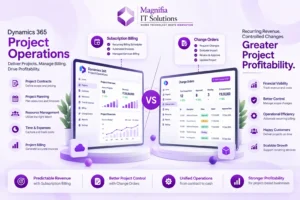
Dynamics 365 Project Operations is designed to connect sales, project management, resource management, and finance processes within a unified business environment. In 2026, new capabilities around subscription billing and change order management are making Project Operations even more relevant for organizations that manage complex project-based and recurring-service businesses. Microsoft Learn
For companies delivering consulting, technology services, implementation projects, engineering services, professional services, managed services, or recurring customer engagements, these capabilities can help create a more structured approach to billing and project change management.
In this guide, we explore how Dynamics 365 Project Operations handles subscription billing and change orders, why these capabilities matter, common use cases, implementation considerations, and how Magnifia IT Solutions can help businesses modernize their project operations.
What Is Dynamics 365 Project Operations?
Dynamics 365 Project Operations is a business application designed for organizations that manage project-centric operations.
It brings together important processes across the project lifecycle, including:
- Sales and opportunity management
- Project contracts
- Project planning
- Resource management
- Time and expense management
- Project costing
- Project billing
- Invoicing
- Project accounting
- Financial management
- Project performance monitoring
The objective is to provide better visibility from the initial customer opportunity through project delivery and financial completion.
Instead of maintaining separate systems for sales, project management, resource planning, and finance, organizations can connect these processes so teams have a more consistent view of project performance.
This is particularly valuable for businesses where project profitability depends on accurate estimates, resource utilization, customer billing, change management, and financial control.
Why Subscription Billing Matters for Project-Based Businesses
Traditional project billing is often based on milestones, fixed-price agreements, time and materials, or deliverables.
However, many modern businesses operate using hybrid models.
A customer might purchase:
- An initial implementation project
- Monthly support
- Annual maintenance
- Recurring consulting services
- Managed services
- Cloud or technology subscriptions
- Recurring licensing
- Ongoing optimization services
This means the organization needs to manage both project-based and recurring revenue.
Subscription billing can help businesses establish predictable billing schedules while maintaining the relationship between recurring charges and the underlying project or contract.
In the 2026 Project Operations roadmap, subscription billing support is a specific investment area, with capabilities designed to support recurring billing scenarios and improve the connection between project operations and financial processes. Microsoft Learn
How Subscription Billing Works with Dynamics 365 Project Operations
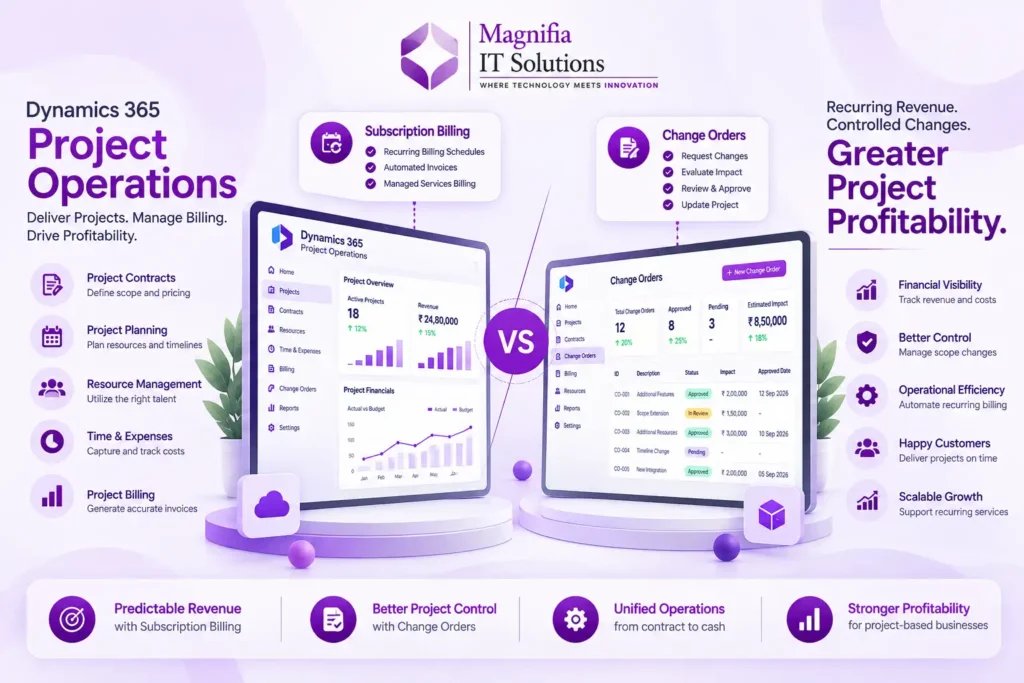
Subscription billing allows organizations to establish recurring charges based on defined billing schedules.
For example, consider a technology consulting company that implements an ERP solution for a customer.
The initial implementation may be a fixed-price project, but after implementation the customer may purchase a monthly managed-support package.
The business now has two different commercial components:
Implementation: Project-based billing
Managed Support: Recurring subscription billing
A connected project and billing environment can help finance teams manage these different revenue streams more efficiently.
Depending on the deployment and configuration, project-related billing schedules can be integrated with project invoicing processes so recurring charges can be included with project-related billing. Microsoft Learn
This can reduce the need for disconnected spreadsheets and manual recurring invoice processes.
Key Benefits of Subscription Billing
1. Predictable Recurring Revenue
Subscription-based services can create more predictable revenue streams for businesses.
Finance teams can track recurring billing commitments and use them for revenue planning and forecasting.
2. Automated Recurring Invoices
Instead of manually creating invoices every month or quarter, organizations can establish predefined billing schedules.
This can reduce repetitive administrative work and help improve billing consistency.
3. Better Financial Visibility
When project-related services and recurring charges are managed within connected processes, finance teams can gain better visibility into customer billing and project financial performance.
4. Reduced Billing Errors
Manual recurring billing processes can create errors such as incorrect amounts, missed invoices, duplicate invoices, or incorrect billing periods.
Structured billing schedules can help reduce these risks.
5. Scalable Subscription Models
As businesses expand their managed services and recurring revenue offerings, structured subscription billing can make it easier to manage a growing number of customers and contracts.
Subscription Billing Use Cases
Subscription billing can be particularly useful for organizations operating in industries such as:
- IT consulting
- Software services
- Managed services
- Professional services
- Engineering
- Construction
- Telecommunications
- Cloud services
- Technology implementation
- Business process outsourcing
For example, an IT services company could have a customer contract that includes a one-time Dynamics 365 implementation followed by a 12-month managed support agreement.
Project Operations can help organizations manage the project lifecycle while subscription billing capabilities support recurring commercial arrangements.
What Are Change Orders?
Project requirements rarely remain completely unchanged from the beginning to the end of a project.
Customers may request:
- Additional features
- New integrations
- Additional consulting hours
- Additional resources
- New project phases
- Scope extensions
- Additional deliverables
- Changes to timelines
- Changes to project requirements
These modifications can affect project cost, schedule, resources, profitability, and customer billing.
A change order provides a structured way to manage these changes instead of allowing scope adjustments to happen informally.
Dynamics 365 Project Operations includes investment in Change Order Management as part of its modern project operations capabilities. Microsoft Learn
Why Change Order Management Is Important
Without a structured change management process, project teams can face scope creep.
For example, a customer might request three additional reports during an ERP implementation.
If the project team completes the work without formally documenting the change, the organization could incur additional costs without recovering the revenue.
This can reduce project profitability.
A structured change order process can help organizations document changes, evaluate their impact, obtain appropriate approval, and update the project accordingly.
How Dynamics 365 Change Orders Can Improve Project Control
A typical change order process can involve several stages.
Step 1: Identify the Change
The project manager or customer identifies a change to the agreed scope.
Step 2: Evaluate the Impact
The project team evaluates how the change affects:
- Cost
- Resources
- Timeline
- Deliverables
- Project profitability
- Customer billing
Step 3: Prepare the Change Request
The requested change is documented with the required project and commercial information.
Step 4: Review and Approve
The change can go through the organization’s approval process.
Step 5: Update the Project
Once approved, the relevant project information can be updated.
Step 6: Track the Financial Impact
The organization can monitor how the approved change affects project costs, revenue, and profitability.
This creates a more controlled approach to project scope management.
Subscription Billing + Change Orders: A Powerful Combination
One of the biggest advantages comes from looking at subscription billing and change orders together.
Consider a managed-services provider.
A customer starts with a monthly support subscription covering 100 service hours.
After six months, the customer wants to increase the agreement to 150 hours and add additional services.
This creates a commercial change.
Instead of managing the adjustment through email and spreadsheets, the organization can use structured project and contract processes to document the change, review the financial impact, and update the recurring billing arrangement.
This creates better alignment between:
Customer Requirement → Change Order → Project Scope → Resources → Billing → Finance
That connection is particularly important for growing service organizations.
Dynamics 365 Project Contracts and Billing
Project contracts are central to managing the commercial relationship between a business and its customers.
Project Operations supports project contracts that capture agreed commitments and billing details. Contract lines can represent high-level components of the work, while contract line details can capture estimated schedule and financial information. Microsoft Learn
This structure provides an important foundation for managing different billing models.
Businesses can define how customers will be charged based on the nature of the project and services being delivered.
For organizations with multiple projects and customers, this can provide better visibility into contract commitments and project financial performance.
Fixed-Price vs Time-and-Material vs Subscription Billing
Project businesses often use different billing models.
Fixed-Price Projects
The customer agrees to a defined price for a specific scope of work.
This model is common for implementation projects, construction projects, and defined deliverables.
Time and Material
Customers are billed based on actual resources, hours, expenses, or other applicable project transactions.
This model is common for consulting and professional services.
Subscription Billing
Customers pay a recurring amount based on an agreed schedule.
This is common for managed services, maintenance, support, recurring consulting, and technology services.
Hybrid Billing
Many modern organizations use a combination of all three.
For example:
ERP Implementation: Fixed Price
Additional Consulting: Time and Material
Managed Support: Monthly Subscription
A modern project operations platform needs to support these different commercial models while maintaining financial visibility.
How Subscription Billing Can Support Recurring Services
Recurring services often require predictable processes.
For example, a business may provide a customer with:
- Monthly application support
- Quarterly consulting
- Annual maintenance
- Recurring cloud services
- Managed infrastructure
- Continuous ERP optimization
The billing schedule can define when recurring charges should be generated.
In supported Project Operations and ERP scenarios, project-related billing schedules can work with project invoice processes, allowing recurring billing charges and project transactions to be handled together within the broader project financial process. Microsoft Learn
This can help reduce manual billing activities and provide a more consistent customer invoicing process.
Revenue Recognition and Financial Control
Recurring services can create additional accounting considerations.
A business may receive payment or issue invoices for a service covering a future period.
Financial teams may need to recognize revenue according to the period in which the service is delivered.
Project-related subscription billing scenarios can therefore require appropriate deferral and revenue recognition processes.
Project billing and deferral capabilities can help organizations manage revenue or costs over a defined period rather than recognizing everything at once. Microsoft Learn
This is particularly important for businesses managing annual subscriptions or long-term service contracts.
Business Benefits of Dynamics 365 Project Operations in 2026
Organizations adopting modern Project Operations capabilities can gain several benefits.
Better Project Profitability
By connecting project costs, billing, resources, and contract changes, businesses can gain greater visibility into profitability.
Improved Billing Accuracy
Structured billing schedules and contract management can reduce manual billing errors.
Faster Change Management
Formal change processes can help teams respond to customer requirements without losing financial control.
Reduced Administrative Work
Automation can reduce repetitive tasks associated with recurring invoices and project updates.
Better Customer Visibility
Teams can maintain clearer information about what was agreed, what changed, and what is being billed.
Improved Forecasting
Recurring revenue information can support financial planning and forecasting.
Greater Operational Control
Connecting sales, projects, resources, and finance helps management understand the complete project lifecycle.
Challenges to Consider Before Implementation
Technology alone does not guarantee a successful project operations implementation.
Businesses should evaluate several areas before introducing subscription billing and change order processes.
Business Process Design
First, document the existing process.
Understand how contracts are created, how changes are approved, how projects are delivered, and how invoices are generated.
Data Quality
Customer, project, contract, pricing, resource, and financial data should be accurate and consistent.
Approval Workflows
Define who can approve changes, discounts, additional work, and billing modifications.
Financial Configuration
Subscription billing and project accounting should align with the organization’s finance policies.
Integration
If the business uses CRM, ERP, payment platforms, payroll systems, reporting platforms, or third-party applications, integrations should be planned carefully.
User Training
Project managers, finance teams, sales teams, and consultants should understand how the new process works.
How Magnifia IT Solutions Can Help
Implementing Dynamics 365 Project Operations successfully requires more than configuring software.
Businesses need to connect technology with real-world project processes, financial requirements, customer contracts, resources, integrations, and reporting.
Magnifia IT Solutions helps organizations plan, implement, customize, integrate, and optimize Microsoft Dynamics 365 solutions around their business requirements.
Our services include:
- Dynamics 365 consulting
- Dynamics 365 Project Operations implementation
- Project contract configuration
- Project billing setup
- Subscription billing solutions
- Change order process design
- Dynamics 365 Finance integration
- Data migration
- System integration
- Customization and development
- Power Platform automation
- Reporting and business intelligence
- Dynamics 365 upgrades
- User training
- Support and managed services
For organizations moving from manual spreadsheets or disconnected project and finance systems, Magnifia can help design a scalable solution that connects project delivery with financial management.
Whether your business needs fixed-price project billing, time-and-material billing, recurring subscription services, change order management, or a combination of these models, our team can help create a structured Dynamics 365 strategy.
Why Choose Magnifia for Dynamics 365 Project Operations?
Every project-based organization has different commercial models and operational requirements.
Magnifia focuses on understanding the business process before recommending the technology solution.
Our approach can include:
Discover: Understand your existing project, billing, contract, and finance processes.
Design: Create a Dynamics 365 solution aligned with your business requirements.
Implement: Configure Project Operations and related Dynamics 365 applications.
Integrate: Connect ERP, CRM, Power Platform, reporting, and other required systems.
Migrate: Move relevant customer, project, contract, and financial data into the new environment.
Automate: Reduce repetitive activities using workflows and automation.
Train: Help employees understand the new processes and tools.
Support: Provide ongoing optimization, troubleshooting, and managed services.
Frequently Asked Questions
What is Dynamics 365 Project Operations?
Dynamics 365 Project Operations is a project-centric business application that connects sales, project management, resource management, and finance processes.
Does Dynamics 365 Project Operations support subscription billing?
Subscription billing is a major area of Project Operations investment in 2026, with capabilities designed to support recurring billing scenarios. Availability and exact functionality depend on the deployment and configuration. Microsoft Learn
What is a change order in project management?
A change order is a formal mechanism for documenting and managing changes to an approved project scope, cost, schedule, resources, or deliverables.
Why are change orders important?
Change orders help organizations control scope changes and understand their impact on project cost, resources, timeline, revenue, and profitability.
Can subscription billing and project billing work together?
In supported Project Operations and ERP scenarios, recurring billing schedules can be connected with project invoice processes, allowing recurring charges to be included within project-related billing workflows. Microsoft Learn
Which businesses can benefit from subscription billing?
IT services companies, consulting firms, managed service providers, professional services organizations, engineering companies, technology businesses, and other project-centric organizations can benefit from recurring billing capabilities.
Can Magnifia implement Dynamics 365 Project Operations?
Yes. Magnifia IT Solutions can support Dynamics 365 consulting, implementation, integration, customization, migration, automation, training, and ongoing support for project-centric businesses.
Conclusion
Dynamics 365 Project Operations: Subscription Billing & Change Orders in 2026 represents an important development for organizations that need better control over project delivery, recurring revenue, customer contracts, and financial operations.
Subscription billing can help businesses manage recurring services and establish more predictable billing processes, while change order management can provide better control over scope changes and their financial impact.
Together, these capabilities can help project-centric organizations create a more connected process from customer contract to project delivery, change management, invoicing, and financial reporting.
For organizations delivering consulting, implementation, managed services, engineering, technology, or other project-based services, the combination of Dynamics 365 Project Operations, subscription billing, and structured change management can provide a strong foundation for scalable growth.
The key is implementing these capabilities around clearly defined business processes rather than simply enabling technology.
Magnifia IT Solutions can help your business build a smarter and more connected project operations environment. From Dynamics 365 Project Operations consulting and implementation to subscription billing, change order management, integration, data migration, customization, automation, training, and ongoing support, our team can help you turn complex project operations into a more efficient and scalable business process.
Ready to modernize your project billing and project operations? Contact Magnifia IT Solutions today and let our Dynamics 365 experts help you design a solution built around your business.